When I developed Samsung Pay in the past, our goal was to replace the wallet tucked in the back pocket with the wallet app on the Galaxy phone. The result was a half-success: we managed to replace the cards in the wallet with Samsung Pay’s easy payment feature, but unfortunately, there was no technology to replace the cash and coins inside the wallet. Of course, Bitcoin existed even then, but in a large corporate environment, the idea of using cryptocurrency was simply unthinkable.
In 2018, as I entered the blockchain market, I believed that the success of blockchain-based cryptocurrencies would come from their use in everyday activities such as payments and remittances. In 2020, I created the first Indonesian Rupiah-based stablecoin in Korea and commercialized it in Indonesia. Since then, I have continued to emphasize in external lectures and presentations the importance of paying attention to both CBDCs and stablecoins.
In the world of cryptocurrencies, I saw stablecoins as important, while in the real world, I believed CBDCs would have a stronger influence. This is because CBDCs are being driven by central banks in each country, while stablecoins had been subject to regulatory scrutiny. However, this trend changed after President Trump took office in the United States. The U.S. halted its CBDC initiatives and began to promote stablecoins. Of course, there are various complex reasons, but stablecoins have now become the center of attention.
Central Bank Digital Currencies (CBDCs) and stablecoins-both have the potential to revolutionize the traditional monetary system, but many people are curious about the differences between the two and how they might relate in the future. If CBDCs are introduced, will stablecoins really become unnecessary?
💡 To give the conclusion first:
CBDCs and stablecoins share some similarities, but there are fundamental differences in terms of their issuers, trust structures, methods of control, and the values they pursue. At this point in time, it appears unlikely that the introduction of CBDCs will completely eliminate stablecoins. On the contrary, it is highly likely that each will leverage its own strengths to develop the digital financial ecosystem in a complementary way.
Let’s take a closer look below.
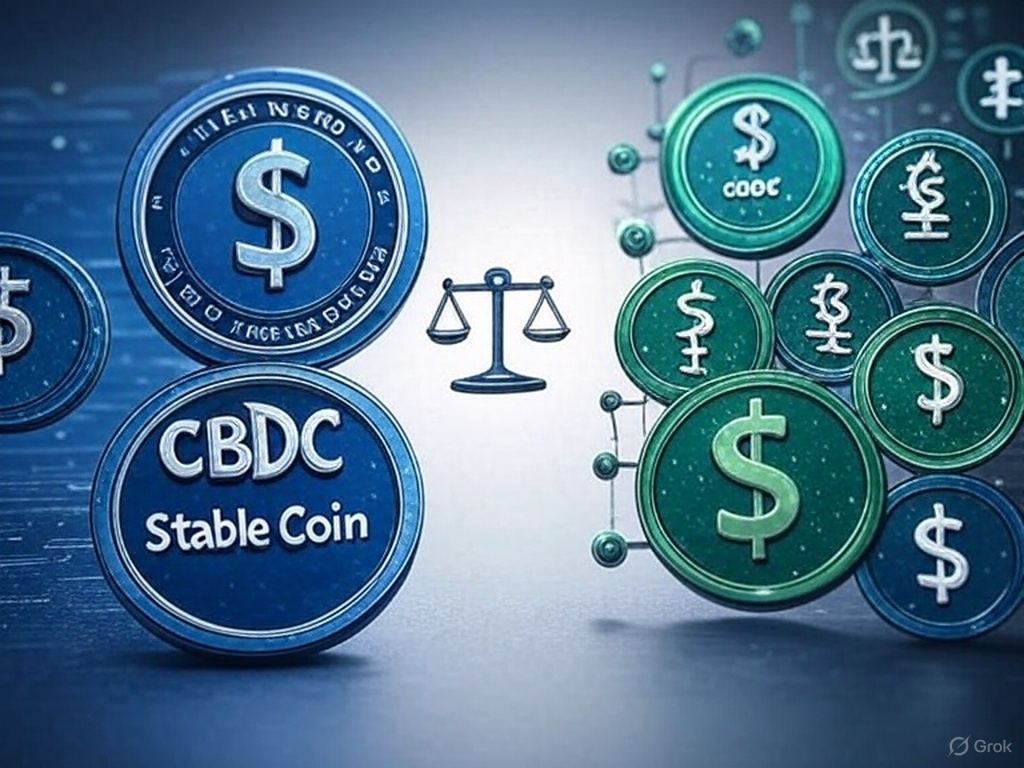
🚀 What’s Similar? The Common Ground of Digital Currencies
CBDCs and stablecoins share several important similarities.
- Digital Form: Unlike paper money or coins, both are currencies based on digital technologies such as blockchain. Though invisible, they possess the power to transform our financial lives.
- Pursuit of Value Stability: Unlike highly volatile virtual assets like Bitcoin, both aim to maintain a 1:1 value peg with fiat currencies such as the dollar or the won. This makes them well-suited to serve as a “measure of value” and a “medium of exchange,” increasing their potential for use in everyday payments and remittances.
- Efficient Remittance and Payment: They have the potential to process cross-border remittances and payments faster and more cheaply than traditional financial systems. This innovation can enhance financial accessibility and reduce costs.
🔍 What’s Different? The Decisive Differences
Despite surface similarities, CBDCs and stablecoins are fundamentally different from the outset. Let’s summarize the key differences in a table and examine them in detail.
| ✅ Central bank (government) | Private companies or project teams | |
| Legal Status | ✅ Legal tender (state-backed) | Legal status unclear (varies by country) |
| Trust Basis | ✅ 100% guaranteed by the central bank | Reserves, collateral, or algorithms of the issuer |
| Control/Supervision | ✅ Directly controlled and managed by the government | Operated autonomously by private sector (subject to regulation) |
| Personal Information | Possible government oversight (privacy concerns) | Blockchain-based anonymity/pseudonymity (regulatory risk) |
| Scalability/Circulation | Dependent on national policy | ✅ Freely circulated on global blockchain networks |
| Policy Role | ✅ Public functions: monetary policy, financial stability, financial inclusion | Innovation in virtual asset markets: payments, DeFi, etc. |
Detailed Analysis of Key Differences
Source of Trust:
CBDCs are "digital legal tender" issued and guaranteed directly by the state. Unless a country defaults, there is virtually no risk of loss. In contrast, stablecoins rely on the credit or collateral of private companies, or on algorithms. As seen in controversies over Tether (USDT) reserves or the depegging of algorithmic stablecoins, the risk of the issuer becomes the risk of the coin itself.
Control and Privacy:
CBDCs allow governments to monitor transaction histories, which is advantageous for anti-money laundering but raises concerns about personal privacy, as seen in "Big Brother" debates. Stablecoins, by nature of blockchain technology, can offer anonymity or pseudonymity, but this also makes them a target for regulatory scrutiny due to potential misuse for illicit transactions.
Innovation and Scalability:
Stablecoins, built on public blockchains and combined with smart contracts, are well-suited for creating innovative services such as decentralized finance (DeFi). Their borderless mobility is a significant advantage. On the other hand, CBDCs are tied to national infrastructures and policies, which can limit the speed of innovation and global scalability compared to privately driven stablecoins.
Ultimate Goals:
CBDCs focus on public interests such as enhancing monetary policy effectiveness, stabilizing the financial system, and promoting financial inclusion. Stablecoins, meanwhile, emphasize practicality and innovation in the virtual asset market, facilitating convenient transactions, fast cross-border remittances, and expanding the DeFi ecosystem234.
💥 Future Outlook: Competition vs. Coexistence-Who Will Prevail?
Will stablecoins lose their place if CBDCs are fully introduced?
Potential for Competition/Substitution:
Some believe so. As a reliable means for payment and remittance, CBDCs could outcompete private stablecoins in terms of trust. Historical precedents, such as the U.S. Treasury Advisory Committee’s reference to the consolidation of private currencies into central bank money, are cited to argue that CBDCs should become the standard for digital currency. Research also suggests that even the discussion of CBDC introduction can dampen demand for stablecoins.
Potential for Coexistence/Complementarity:
However, most experts lean toward "coexistence" rather than complete substitution, as CBDCs and stablecoins have different roles and strengths:
- CBDC: Core strengths are "trust and stability" backed by the state. Likely to be used for domestic retail payments or large-value wholesale payment systems.
- Stablecoin: Strengths lie in "innovation, flexibility, and global scalability." They are expected to continue serving roles in areas difficult for CBDCs to cover, such as DeFi, NFTs, P2E, and fast global remittances.
If CBDCs are designed as centralized systems, diverse innovations based on public blockchains will likely remain the domain of stablecoins. Furthermore, if CBDCs are primarily designed for domestic use, stablecoins will retain their utility in global markets.
This analysis reflects the current expert consensus and regulatory trends, indicating a future where CBDCs and stablecoins coexist, each fulfilling distinct needs in the evolving digital financial ecosystem.
'블록체인' 카테고리의 다른 글
| 🇰🇷 원화 스테이블 코인, 정말 필요할까요? 핵심은 '수익'과 '제도'입니다! 💸 (1) | 2025.05.15 |
|---|---|
| Stripe's Quiet Revolution: Rebuilding Global Finance with Stablecoin Accounts (1) | 2025.05.09 |
| Stripe 스테이블코인 금융 계정 출시, 글로벌 금융의 게임체인저 될까? (1) | 2025.05.09 |
| Is Ethereum Stepping Down from the Throne? (0) | 2025.05.05 |
| 이더리움, 왕좌에서 내려오나? 추락하는 이유와 비탈릭의 'L1 단순화' 승부수 (0) | 2025.05.05 |
| 스테이블코인 시대 , CBDC는 사라질까? (0) | 2025.04.30 |
| 국내 STO , 누구를 위한 것인가? (0) | 2025.03.23 |
| 김치프리미엄과 한국 블록체인 (1) | 2025.02.17 |
| 트럼프 당선 이후 가상자산 시장의 주요 변화는 무엇인가? (1) | 2025.02.03 |
| [강의자료 공유] 블록체인 디지탈 자산 이야기 (1) | 2025.01.31 |